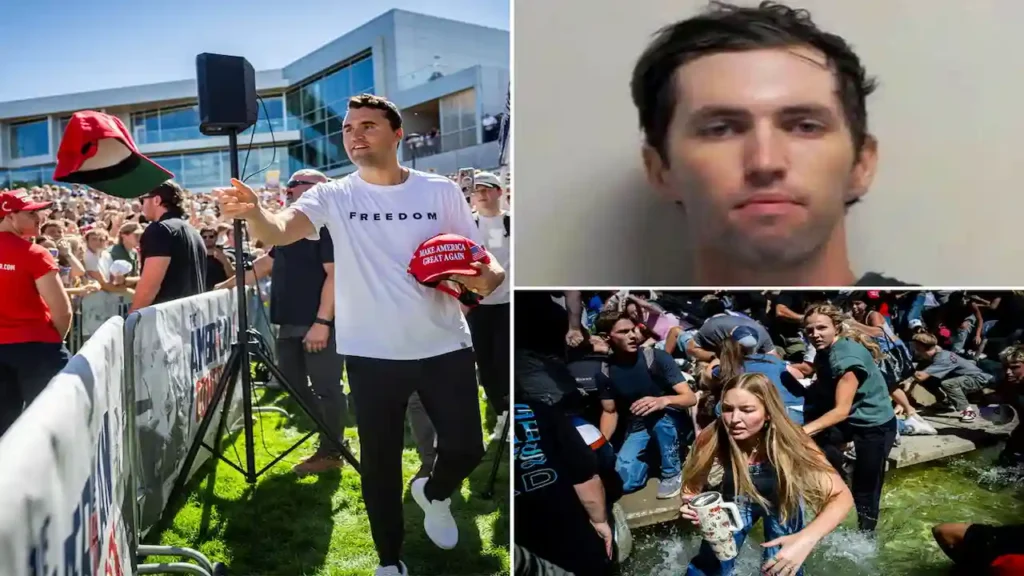

The shocking killing of conservative commentator Charlie Kirk in Utah has become one of the most debated and trending stories worldwide. With new revelations surfacing daily, the case has taken a dramatic turn as Utah Governor Spencer Cox revealed that the suspect, Tyler Robinson, had a “very different ideology” compared to his conservative Republican family. This disclosure has added another layer of complexity to the investigation, raising questions about political polarization, online radicalization, and how family backgrounds no longer guarantee shared beliefs.
This article dives deep into the suspect’s background, the family’s contrasting ideology, the governor’s statements, and the broader implications for American society and politics.
The Shooting Incident
On September 12, 2025, Charlie Kirk, the founder of Turning Point USA and a popular conservative figure, was shot and killed while addressing students during the “American Comeback Tour” at Utah Valley University.
The attack sent shockwaves across the nation. Kirk, a polarizing but highly influential political commentator, was speaking to a packed auditorium when shots were fired from a distance. Authorities later confirmed that Robinson allegedly positioned himself on a rooftop about 200 yards away, firing at the event before turning the gun on himself.
While initial reports suggested political motives, investigators have since been piecing together the suspect’s online activity, family history, and ideological leanings.
Tyler Robinson: Who Is the Suspect?
Tyler Robinson, 22, was not widely known before the shooting. He grew up in Utah in a deeply conservative family. His parents were registered Republicans and actively supported conservative policies. Robinson, however, registered himself as unaffiliated when he came of voting age.
Reports suggest that Robinson’s personal views leaned strongly toward leftist ideology. Investigators found evidence that he frequently engaged with online subcultures critical of right-wing politics. His social media footprint points toward discussions on forums and Discord servers where anti-conservative sentiments were common.
What makes the case even more dramatic is the contrast between Robinson and his family. While his parents were proud of their Republican values, Robinson distanced himself, reportedly clashing with relatives over political topics.
Governor Cox’s Statement
Utah Governor Spencer Cox confirmed the ideological divide during a press conference. According to Cox, Robinson’s ideology was “very different” from that of his conservative family. He emphasized that while the family had Republican roots, Robinson appeared to have moved in the opposite direction politically.
Skye Valadez : Utah Musician at the Center of the Charlie Kirk Controversy
The governor also acknowledged the radicalization risk in online spaces, stating that young people are increasingly influenced by internet communities rather than traditional family or community values.
This statement has fueled debates across the country, as it highlights how generational and ideological divides are deepening within families.
Online Radicalization and Influence
Investigators are now focusing on Robinson’s online activities. Reports indicate that he may have spent long hours engaging in discussions on social media and forums that criticized conservative politics. His digital footprint allegedly shows a shift in political beliefs shaped by interactions with online communities rather than real-world activism.
This pattern mirrors a growing concern among experts — that young individuals are increasingly radicalized not through traditional political groups but through online echo chambers. Whether on Reddit, Discord, or fringe websites, these spaces create environments where extreme ideologies thrive.
Public Reactions
The public’s response to the revelations about Robinson’s ideology has been mixed and emotional.
-
Conservatives’ Outrage: Many conservatives see this as proof of the dangers of left-wing rhetoric, accusing progressives of fueling hatred against right-wing voices.
-
Liberals’ Concern: Progressives, while condemning the violence, caution against labeling the entire left based on one individual’s actions.
-
General Debate: Many Americans are concerned about how families can raise children with one set of values only for them to drift into entirely different political camps — sometimes with tragic consequences.
The tragedy has reignited debates over free speech, political discourse, and the role of social media in shaping young minds.
The Role of Family and Identity
Robinson’s story illustrates a broader theme in modern America: family ideology is no longer a guarantee of individual ideology. Generational shifts, cultural changes, and digital influences mean children are often exposed to diverse viewpoints that may conflict with their parents’ beliefs.
In this case, Robinson’s “different ideology” didn’t just cause political differences at the dinner table; it culminated in a violent act that shocked the nation. Experts are now asking whether American families are equipped to handle these divides or if the gap will only widen in coming years.
Controversies and Unanswered Questions
The case has sparked several unanswered questions that remain central to the investigation:
-
Was Robinson’s attack politically motivated or driven by personal issues?
-
How much influence did online communities have in shaping his views?
-
Could law enforcement have identified red flags earlier, given his online activity?
-
Did Robinson act alone, or were there influences from others in his network?
These questions underline how complex the case is, and investigators have yet to provide conclusive answers.
National and Global Reactions
Globally, the shooting has drawn attention as another example of increasing political violence in the United States. International media has compared it to other high-profile political assassinations and attacks in history.
Nationally, the tragedy has become a rallying point for discussions on:
-
Gun control and firearm regulations.
-
The role of universities and free speech.
-
The dangers of extreme political polarization.
The Bigger Picture: America’s Polarization
At its core, the Kirk shooting represents the darker side of America’s ideological divide. A young man with beliefs that clashed with his conservative upbringing allegedly resorted to violence, killing one of the country’s most visible conservative figures.
Experts argue that this is a warning sign — that unchecked polarization, combined with online radicalization, could lead to more violence if not addressed.
Conclusion
The tragic death of Charlie Kirk and the revelations about Tyler Robinson’s “very different ideology” from his conservative family have become a defining story of 2025. It is not just about one shooting but about the deeper ideological divides tearing through American families, communities, and politics.
Governor Spencer Cox’s statement sheds light on how young people are often pulled into entirely different ideological worlds, sometimes with devastating consequences. As investigations continue, one thing is clear: the Kirk shooting has opened a painful but necessary discussion about polarization, online influence, and the fragile state of American democracy.


