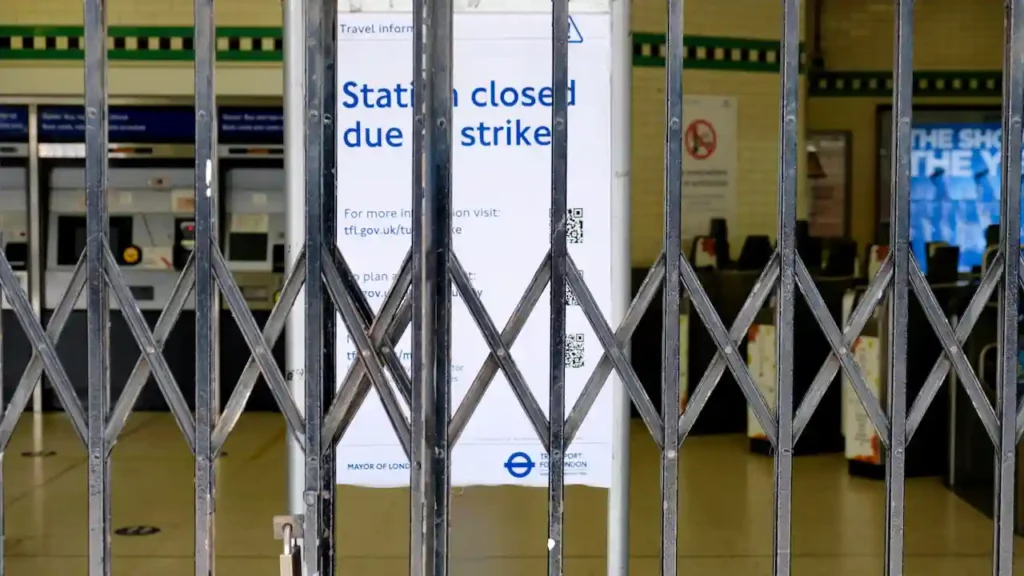

Tube Strike 2025: The beating heart of London’s transport network has once again come to a halt. The London Tube strike of September 2025 has created one of the most significant disruptions in recent memory, affecting millions of commuters and costing the city hundreds of millions of pounds. For a city that thrives on its fast-paced connections, the strike has highlighted not only the dependency of Londoners on the Underground but also the deep frustrations between workers, unions, and management.
Tube Strike 2025: Why the Strike Happened
At the center of the Tube strike are disputes over pay, working conditions, and job security. The RMT union, which represents thousands of Underground staff, signallers, and station controllers, called the strike after months of failed negotiations with Transport for London (TfL).
Union leaders argue that rising inflation, increased workloads, and a lack of fair pay adjustments have pushed workers to breaking point. They also claim that automation and cost-cutting measures threaten job security, making the strike not just about wages but about the future of the workforce.
Management, on the other hand, insists that budget constraints and falling revenue since the pandemic make it impossible to meet all demands. This deadlock has escalated into a six-day strike that has left commuters stranded.
Scale of the Disruption
The strike began on Friday, September 5, 2025, and is set to continue until Thursday, September 11. Over 10,000 RMT members have walked out, effectively shutting down large parts of the London Underground.
Passengers who normally rely on the Tube are being forced onto alternative modes of transport. The Elizabeth Line, London Overground, and bus services are still running, but they are overcrowded and delayed as they attempt to handle the massive surge in demand.
Traffic congestion has surged across the city, with reports of journey times doubling in central London. For businesses, schools, and hospitals, the disruption has been significant, with many employees unable to reach work on time.
Economic Impact
The financial consequences of the strike are staggering. Economists estimate that each full day of disruption costs the London economy tens of millions of pounds, with the total six-day strike expected to surpass £230 million in losses.
Businesses in retail, hospitality, and tourism are hit especially hard. Tourists, unfamiliar with alternative routes, face frustration, while local shops near Underground stations are losing regular commuter footfall. Larger corporations are relying on remote work, but for industries that depend on physical presence, the strike is a major setback.
Commuter Experiences
For everyday Londoners, the strike has been nothing short of chaotic. Long queues at bus stops, packed Overground trains, and a scramble for bicycles and scooters have become the new normal. Many commuters have expressed sympathy for workers’ demands, but the daily struggle of reaching offices and schools has also sparked anger.
Some residents have taken to walking miles to reach their destinations, while others are working entirely from home. Social media has been flooded with photos of overcrowded platforms, packed buses, and sarcastic memes highlighting the frustration of the week.
The Union’s Standpoint
Union leaders have defended the strike, arguing that short-term disruption is necessary for long-term justice. They stress that London Underground workers are the backbone of the city’s transport system and deserve fair treatment.
The RMT has emphasized that this strike was a last resort, after multiple attempts at negotiations failed. They accuse TfL of failing to take workers’ concerns seriously and insist that unless changes are made, further industrial action is possible.
Government and TfL Response
The government has called for both sides to return to the negotiating table, warning that prolonged strikes damage not only London’s economy but also its international reputation. TfL has expressed regret for the inconvenience caused to passengers but insists that meeting all union demands would be financially unsustainable.
Talks are ongoing, but with both sides holding firm, there is little sign of a quick resolution. Londoners are caught in the middle, paying the price for a dispute far beyond their control.
Broader Implications
The Tube strike has sparked a wider debate about labor relations in the UK. With inflation still biting and workers across industries demanding better pay, industrial action has become increasingly common. The Tube strike is part of a broader wave of strikes in transport, healthcare, and education sectors.
This raises questions about how the government and employers will handle wage disputes in the future. The strike is not just about London’s transport—it reflects a national struggle over fair pay, rising costs of living, and the rights of workers.
Quick Recap of Key Points
-
Strike runs from September 5 to September 11, 2025
-
Over 10,000 RMT union members involved
-
London Underground largely shut, with buses and Overground overcrowded
-
Estimated economic impact: over £230 million
-
Commuters face delays, overcrowding, and longer journeys
-
Future strikes remain possible if no agreement is reached
Looking Ahead
As the strike continues, commuters and businesses are left in limbo, hoping for an agreement. The outcome will depend on whether unions and TfL can find common ground that balances financial realities with workers’ needs.
For Londoners, the Tube strike is a stark reminder of how vital the Underground is to the city’s rhythm. Every halted train, every closed station, and every overcrowded bus illustrates the scale of dependence on this iconic system. Until the dispute is resolved, the city will remain gridlocked—both on the roads and in negotiations.
Conclusion
The London Tube Strike of 2025 is more than a labor dispute—it is a crisis that has exposed the fragility of the city’s transport network, the economic cost of unresolved conflicts, and the growing unrest among workers. While commuters struggle and businesses suffer, the strike has forced London to confront the reality of balancing budgets with fairness, efficiency with justice, and tradition with change.
In the end, the strike may be remembered not just for the chaos it caused, but for the conversation it sparked about the value of labor in a modern city. Whether resolution comes soon or after prolonged battles, the message is clear: London’s future depends on finding harmony between those who run the trains and those who rely on them.


